极简美学驱动:门窗五金革新之路
Minimalist Architecture: Innovations in Window Systems Modern Architecture and the Philosophy of Minimalist Design
In contemporary architectural design and high-end residential spaces, "minimalism" has transcended mere visual trends to become a deep-seated industrial design and engineering mechanics philosophy. Ultra-narrow frames, transparent large glass, and smooth, continuous facade lines place stringent requirements on the window and door systems: how to achieve visual "reduction" while enhancing functionality, strength, and structural accuracy?
As the "core heart" of the whole window mechanical transmission and bearing force, the innovation of the system hardware directly determines whether the minimalist aesthetics can be safely and durably implemented. CMECH Heimeier, a premium window hardware brand from the United States, has developed a technology innovation path driven by "structure隐形" and "details精致" based on the actual application scenarios of global architecture.
Part One: The "Subtraction" of Vision: Restructuring Mechanical Structure to Hide Load-bearing Components from View
Traditional window and door hardware with exposed components and protruding bases often disrupt the flat and continuous sense of the building facade. However, in high-load and large-size scenarios, the blind pursuit of invisibility can easily lead to sagging, loosening, and seal failure. True "invisibility aesthetics" must be based on the breakthrough of mechanical structure.
1. Curtain Wall Outswinging Windows: Breaking the束缚 of traditional bottom-mounted latch lever handles with bidirectional drives
Industry engineering pain points: In the field of public building and high-rise curtain wall outswinging windows, due to the large opening and closing load and stroke, the industry has long relied on traditional bottom-mounted latch lever handles—relying on the internal mechanism of the base to compensate for mechanical transmission and wave difference. This has led to the long-time inability of the minimalist "no base" design to enter the field of curtain wall windows.
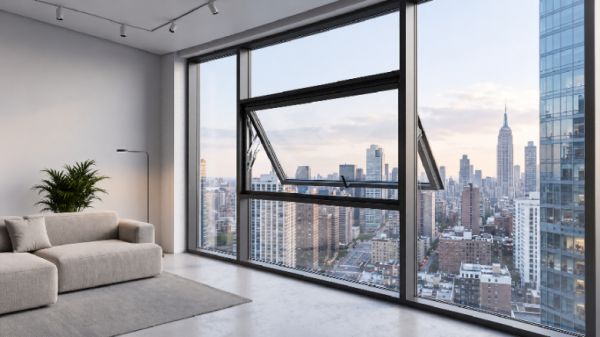
Bidirectional Drive Breakthrough:
CMECH Heimeier, through independently developed bidirectional drives, can free itself from the traditional bottom-mounted latch lever handles, and instead use no base handles, allowing the window surface to balance smooth operation and beauty.
Tr痕less Facade and High-altitude Safety:
With the support of the bidirectional drive, the no base handle (Florence handle) successfully applies to curtain wall outswinging windows. The root of the handle is smoothly fitted with the profile, giving the public building curtain wall the minimalist and sleek texture comparable to high-end luxury homes. Combined with the windproof self-locking lock point lock seat and the telescopic support, it triggers physical self-locking when strong winds invade, strengthening the structural safety defense line of high-rise buildings.
2. Hidden Hinges for Sliding Doors: Hiding the Load-bearing Mechanism in the Gap
For large-size heavy-duty sliding doors, hidden hinges completely hide the entire bearing mechanical rod in the gap between the door frame and door leaf. When the door leaf is closed, there is no exposed metal projection; the high-strength alloy structure and optimized mechanical transmission path effectively distribute the descending force, ensuring that the heavy-duty door leaf does not sag or produce noise when opened and closed frequently.
Part Two: The "Exquisite" Details: Industrial Carving of Tactile Interaction and Installation Flatness
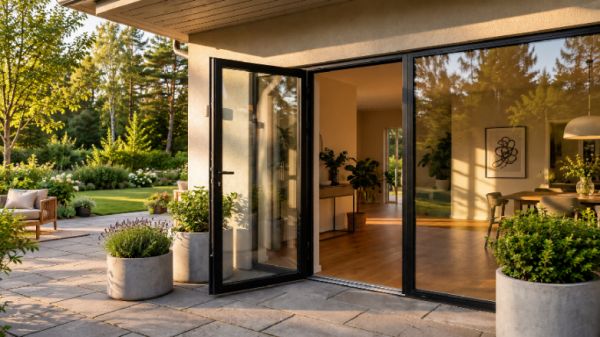
Minimalism does not mean simplicity. The more concise the facade, the more it tests the processing accuracy and engineering practicality of the details. CMECH Heimeier demonstrates its detailed response to construction and post-maintenance pain points in the in-depth development of handles and locking systems.
1. Split Handle: Hidden Screw Positions and Geometric Continuity
In the design of sliding door facades, exposed screws and complex base flanges are likely to disrupt the overall texture. CMECH's split handle is equipped with an independent lock core cover, perfectly covering the installation hole and fixed screw, making the door surface present a seamless and integrated visual effect; with the design of the sliding handle's facade fitting, it gives users a stable hand interaction feedback.
2. 25mm Ultra-narrow Panoramic Door: Boundless Vision
The panoramic sliding door system reduces the visible surface of the groove to 25mm, maximizing the proportion of glass transparency. Combined with the flat installation of the silent buffer lock seat and the concealed anti-mistake point cover plate, the door leaf maintains a sleek geometric order in both open and closed states.
Part Three: The "Addition" of Mechanics: Breaking the High-load Limit of Large-size Window Sashes
The pursuit of "floor-to-ceiling" windows and ultra-transparent glass vision in modern architecture has led to an increase in the volume and weight of window sashes. The hardware system must ensure the ultimate narrow edge frame vision while carrying the super heavy weight.
1. Key Exhibit: Panoramic Sliding Door System (Transparent Vision and Super Light Resistance)
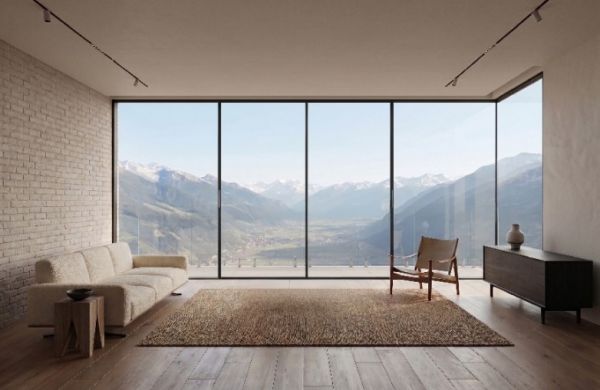
Full-view sliding door system specially designed for ultra-narrow edge frames and ultra-large glass volumes:
Using optimized high-bearing sliding wheel groups and track force distribution, it carries heavy-duty insulating glass while reducing sliding resistance to the lowest level, making the opening and closing silent and smooth;
Strengthening the sealing and wind pressure resistance structure of the overlapping overlapping area, solving the industry-wide problem of leakage and wind leakage in large-area sliding doors, and realizing the maximum采光 area and "boundless" vision.
2. New Product: 150kg Heavy-duty Inward-opening and Inward-tilting Window System
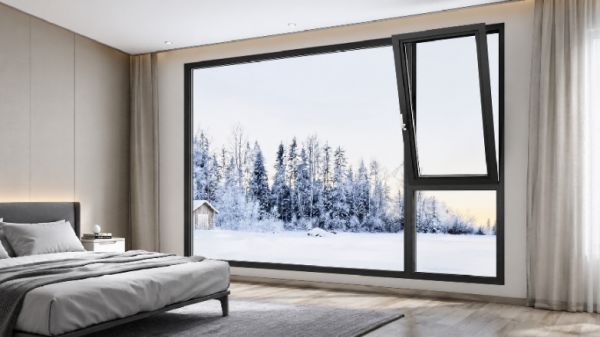
Responding to the strong demand for "large-size floor-to-ceiling windows" in overseas markets, a new 150kg heavy-duty inward-opening and inward-tilting window system has been launched:
Breaking the 150kg Load-bearing Limit: Breaking the traditional inward-opening and inward-tilting hardware load-bearing limit of 100kg-120kg to 150kg, perfectly matching the "floor-to-ceiling" trend of large and heavy glass windows in the overseas market;
Anti-sagging Mechanics: The precise hinge rod and turning angle piece support a 90° opening angle for ventilation, and effectively prevent the window sash from sagging (sagging head) in the long-term suspended state, ensuring long-term opening and closing accuracy.
Part Four: Empowering Windows Manufacturers: Converting Aesthetics Technology into Bidding Power
For export-oriented window manufacturers and construction contractors, choosing hardware systems with technical depth is essentially injecting core competitiveness into their entire window products:
Real Solution to Engineering Pain Points:
From breaking the base restriction of the latch lever handle with bidirectional drives to responding to the global trend of large windows with a 150kg high-load inward-opening and inward-tilting system, to solving the board thickness adaptation and low-cost post-maintenance with split handles, the research and development logic is closely linked to the first-line engineering;
Building Differentiated Premium壁垒:
By transforming physics, mechanics, and industrial design into "data-driven, visible differences" physical selling points, it helps window manufacturers clearly convey the value of the entire window to overseas architects and owners, obtaining high-priced project leads.
相关知识
隐形与精致:现代建筑极简美学驱动下的门窗五金革新之路
瑞纳斯窄边窗五金系统:隐藏铰链,极简通透美学
瑞纳斯窄边内置平开窗五金系统|隐藏式内置铰链,解锁极简通透窗居美学
ISUMER | 极简的门窗美学艺术拨动了城市间的心弦
宾致系统门窗|极简门窗,精致而高级的生活美学
浪眼探好物丨洛兰世嘉简格110:极简至美,演绎家居美学新高度
新标门窗:意式极简,唤醒家呼吸
绿盾门窗新品发布会:极简美学下的科技人居
新标门窗丨意式极简主义,唤醒家的呼吸感
卡森佩格,您的极简奢华门窗
网址: 极简美学驱动:门窗五金革新之路 http://m.jiajubaike.cn/newsview156201.html