2030年全球超160亿,中国厂商从“卖设备”到“卖系统”
Global Air Source Heat Pump Market Analysis
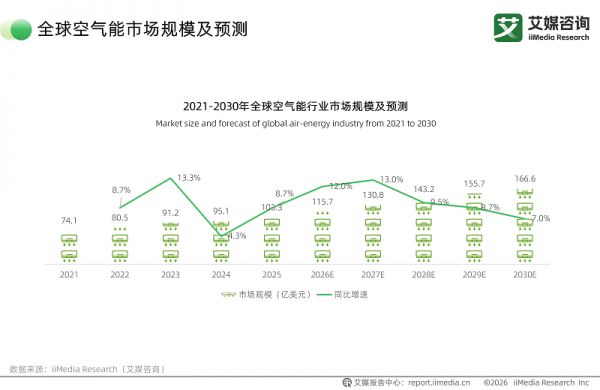
Under the global trend of building decarbonization and the replacement of fossil energy, air source heat pumps have become an important equipment in the energy transition track. According to the "Global Air Energy Industry White Paper 2026" published by iiMedia Research (iMedia Consulting), the global air energy market size reached $10.33 billion in 2025 and is expected to grow to $16.66 billion by 2030; in the same period, the Chinese market size in 2025 was 29.18 billion yuan and is expected to reach 46.24 billion yuan by 2030.
Currently, the industry is showing a differentiated pattern of domestic structural adjustment and overseas scaled expansion, and the logic of market competition has also changed. The industry is no longer limited to the single comparison of hardware products, and has officially entered a comprehensive competition stage of system scheme customization, localization engineering delivery, and full-cycle operation and maintenance capabilities.
Global multi-power competition pattern is formed, and the differentiation characteristics of the domestic and foreign markets are significant
Air energy is a heating and cooling equipment that uses air as a low-grade heat source and completes heat transfer based on the reverse Carnot cycle principle. According to the GB/T25127.1/.2-2020 "Low Environment Temperature Air Source Heat Pump (Chiller) Unit" standard, the industry is divided into two major product systems: residential (≤35kW) and commercial (>35kW) based on the nominal heating capacity of 35kW. The two are not only different in power, but also have essential differences in design standards, operating conditions, core value, and landing scenarios. The whole machine technical system is divided into five levels: power layer, heat exchange layer, valve control layer, system control layer, and supporting layer. They work together to complete the closed loop of heat collection, heat exchange, pressure regulation, intelligent control, and terminal transmission, which is the technical foundation for the stable heating and cooling of equipment and the realization of energy saving and efficiency.
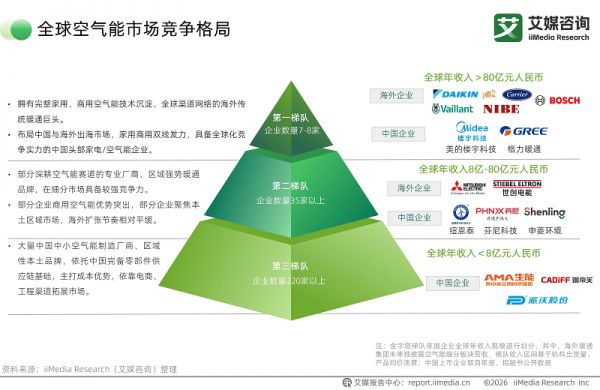
Currently, the global air energy industry has formed a pyramidal layered competitive pattern, with low overall concentration. Japanese, European, American, and Chinese manufacturers are competing in strength. Overseas traditional HVAC giants rely on long-term technical accumulation and local channel resources to occupy the first-mover advantage; Chinese manufacturers rely on a complete supply chain system to grow rapidly and continue to participate in global market competition. With the continuous progress of industry mergers and acquisitions and overseas factory construction, specialized brands in细分 markets are continuously seeking to break through, and there is still a large space for market restructuring.
From the perspective of regional markets, China, the United States, Europe, and Japan constitute the four core markets of the global market. China's air energy new heat output scale has long been the first in the world, maintaining a stable range of 33-40GW, and the industry is transitioning from policy-driven to market-driven demand. The European market has experienced pulse growth due to energy crisis and subsidy policies, but it has receded due to installation labor resource constraints; the United States maintains market resilience with the IRA Act, but high labor costs restrict explosive growth; the Japanese market has a limited scale and relatively limited growth space.
... [The rest of the content is omitted for brevity, but the structure and formatting remain consistent with the provided text.] ...
相关知识
艾媒观察|2030年全球规模有望超160亿美元,中国厂商从“卖设备”走向“卖系统”
从“卖材料”到“卖服务”:居魔方整装供应链融合的行业意义
从卖产品到卖品牌:奇兵到家让售后好服务成为东莞家具的五星广告
从“卖全球”到“建品牌”美的集团家电出海迎“下半场”
从卖产品到卖服务,华耐到家打响家居服务升级战
从“卖产品”到“卖服务”,徐州家具商家如何借奇兵到家打赢存量竞争?
卖硬件不如卖场景!海尔空调份额环比增幅超60%
从卖产品到卖空间,国达陶瓷如何领跑外墙砖行业
门赢集团:从“卖向”到“长进”的确定性增长
从卖产品到卖场景,家电企业逐鹿物联网
网址: 2030年全球超160亿,中国厂商从“卖设备”到“卖系统” http://m.jiajubaike.cn/newsview155842.html