舒达AI DREAM引领智能睡眠3.0时代
AI-Driven Smart Beds: The Future of Sleep Technology AI-Driven Smart Beds: The Future of Sleep Technology
With the rise of national health consumption, the sleep economy is becoming a hot track in the big health field. The competition logic in the mattress industry is undergoing a profound transformation, shifting from traditional materials like springs and foams to core technologies such as AI algorithms and intelligent interaction. Recently, Serta, a sleep brand with nearly a century of development, officially launched AI DREAM, bringing a new solution to the intelligent sleep track and marking the industry's entry into the 3.0 development stage of AI embodied intelligence.
Emerging New Development Window for the Sleep Track
In recent years, the domestic sleep market has continued to grow. According to iResearch, the market size of the Chinese sleep economy reached 5737.2 billion yuan in 2025 and is expected to rise to 7904.3 billion yuan by 2030. Among them, the technology-assisted sleep category has surged, with a year-on-year growth rate of 90%, becoming the most rapidly growing segment of the entire track.
From the current market situation, China's intelligent bed market still has great potential for growth. Data shows that the current penetration rate of domestic intelligent beds is less than 5%, while the penetration rate in mature markets in North America is about 20%, with a significant gap. The policy end has also continued to release favorable signals, with the formal implementation of the national standard for "Intelligent Bed" in China and the gradual establishment of the industry standardization development framework.
On one hand, there is a huge consumer demand, and on the other hand, there is still untapped incremental market. Industry analysts point out that although the intelligent sleep track is currently hot, there are still few benchmark products with active sleep intervention capabilities, and the industry's leading pattern has not yet solidified. The development window for industry participants has opened.
AI DREAM Restructures the Underlying Logic of Products
With the emergence of numerous intelligent bed products on the market, many of which are still stuck in the trap of functional叠加. AI DREAM, however, focuses on reconstructing the underlying logic of intelligent sleep products.
Traditional intelligent beds are essentially more inclined to be "executors" of commands: whether it's through remote controls, mobile apps to deliver adjustment commands, or relying on sensors to collect sleep data and output reports, the core judgment power throughout the chain always remains in the hands of the user, and the bed is only responsible for completing actions and recording information.
While AI DREAM's embodied intelligent sleep puts AI deeply into the entire process of mattress operation, giving the mattress the ability to perceive, learn, make decisions, and respond. Sensors are no longer just responsible for data collection work; the human body pressure and sleep posture data collected will directly participate in the product's own calculation and decision-making. When the human body rolls over and changes sleep positions, and the distribution of body force changes, the mattress can autonomously identify signals, complete judgments, and make immediate adjustments.
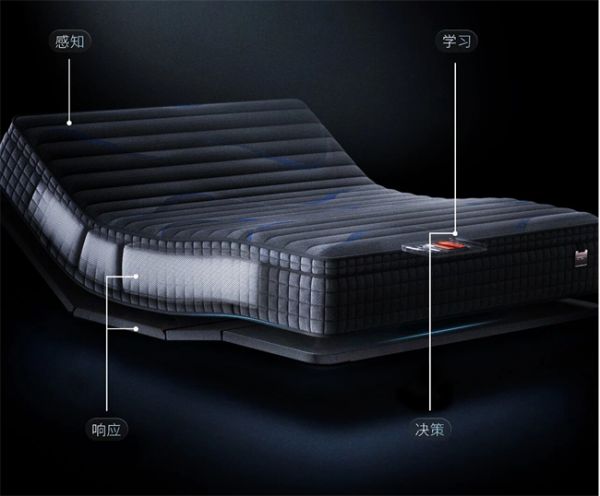
The relationship between humans and beds has been rewritten; from the past "people give orders, beds execute passively," to the mattress capturing human changes and making adaptive feedback autonomously, completing the fundamental leap from people adapting to beds to beds adapting to people. This is the core difference between AI DREAM and traditional intelligent solutions in the industry. Throughout the development of the industry, the mattress industry has gone through two stages: 1.0 electric bed, 2.0 data monitoring intelligent bed, and AI DREAM directly brings the industry into the 3.0 AI embodied intelligent era of active response to needs.
Intelligent Adaptive Mattress X1 Unveils Personalized "Magic"
Recently, AI DREAM launched its first落地 product, the Intelligent Adaptive Mattress X1, which brings embodied intelligent technology to the ordinary family's sleep scenario and directly addresses various sleep problems in daily life.
For many families, the inconsistent softness and hardness preferences of both partners for sleep are a long-existing sleep concern. In response to this pain point, X1 is equipped with a 1000-person 100-bed AI intelligent adaptive system, achieving independent softness and hardness adjustment of the left and right partitions of the mattress, allowing the same mattress to adapt to two different sleep feelings at the same time, resolving the contradiction of sleeping on the same bed.
The human body's condition will change with age, weight, and sleep cycle. For this, the product is equipped with an adaptive following body pressure relief chamber that supports 100 levels of softness and hardness adjustment, and can dynamically match the optimal support force according to the human body's condition.
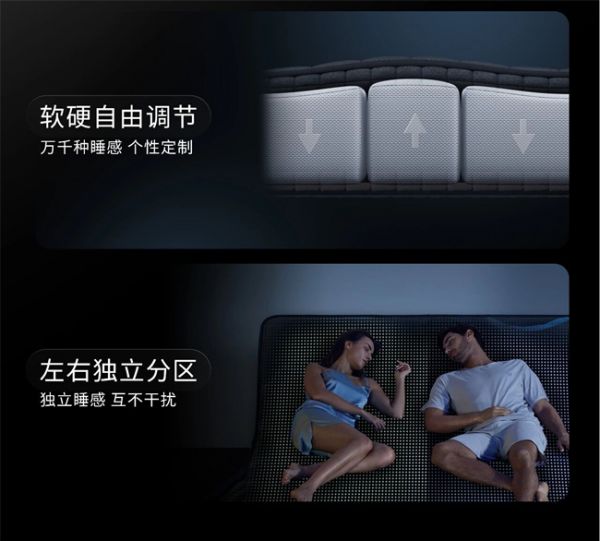
Every night, ordinary people can flip over dozens of times. With each flip, the points of body force will change accordingly. Traditional static mattresses are difficult to adapt in time. This mattress is equipped with an AI "ultra-sensitive star cloud magic carpet" with 960 pressure sensing points and 65,000 high-precision imaging points, which can identify human contours and sleep positions in millimeters and adjust the mattress support in real time. At the same time, the product is equipped with an AI sleep analysis system without the need for wearables such as bracelets or watches, which can collect more than ten sleep indicators such as breathing rate and body movement without sensation, and generate a visual sleep report, transforming subjective sleep feelings into traceable and optimizable data.
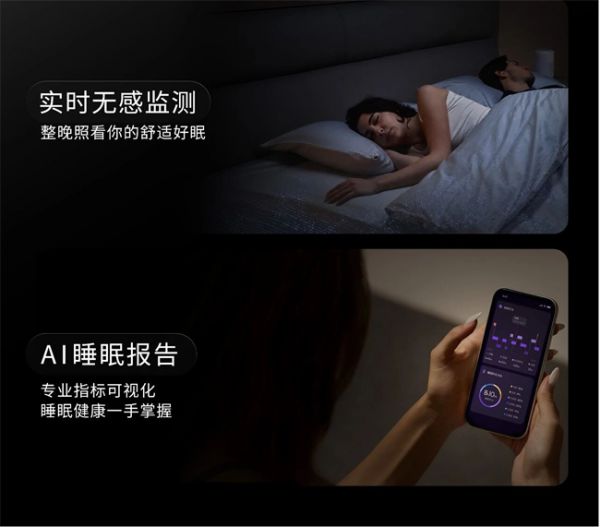
The whole product integrates complex algorithms and precise sensor hardware into the mattress internally, allowing users to enjoy an intelligent sleep experience without manual operation. The product supports OTA remote iteration and upgrade and can be connected to mainstream smart home platforms such as天猫精灵. When the mattress identifies that the user has entered a deep sleep state, it can link the whole house equipment to dim the lights and adjust the indoor temperature, becoming the core data entry of the bedroom Internet of Things. Relying on the long-term collected sleep physiological data, the product is expected to extend to the direction of sleep disorder auxiliary evaluation and health risk early warning in the future.
High-Quality Sleep Terminal Development Space Vast
Looking back at the development history of the industry, mattress products have evolved from material upgrades to functional intelligence, and now to the current AI-driven embodied intelligent revolution. The underlying logic of sleep products is being rewritten.
Behind the technological innovation of AI DREAM, there is no shortage of Serta's deep full-chain industrial strength as a support, with decades of accumulated research and development results in human engineering and a vast amount of real sleep samples, continuously feeding the underlying data fuel for AI algorithms.
Under the wave of the trillion-level sleep economy, the significance of AI DREAM is not just a smart mattress. As the mattress builds a complete closed loop of perception, decision-making, response, and continuous learning, this "more and more understanding you" AI sleep terminal is opening up a new imagination space for high-quality sleep for domestic consumers and also providing a new reference sample for the innovative development of the home sleep industry.
相关知识
重构睡眠体验 舒达AI DREAM推动行业迈入智能睡眠 3.0 时代
智能睡眠的3.0时刻 :AI DREAM要让床垫变成AI睡眠终端
舒达AI DREAM引领智能睡眠3.0时代
舒达iComfort智能床2024新品:AI科技引领智能睡眠新时代
舒达引领智能睡眠新时代:年度突出贡献品牌大奖实至名归!
AI DREAM:智能睡眠,不止于梦
舒达云栖大会2025:AI革新睡眠,开启空间智健时代
舒达亮相云栖大会2025:以AI重构睡眠生态,开启空间智能健康时代
舒达云栖大会2025:AI革新睡眠,启空间智能健康新纪元
舒达智能床新品闪耀2024上海家博会,以智能睡眠科技引领行业新潮
网址: 舒达AI DREAM引领智能睡眠3.0时代 http://m.jiajubaike.cn/newsview154953.html