AI赋能睡眠升级:床垫变AI终端3.0时代
Transforming Sleep: The Story of Serta and AI Dream Transforming Sleep: The Journey of Serta and the Birth of AI Dream
In 1931, during the depths of the Great Depression, 13 mattress manufacturers in Illinois, United States, came together to form a new company. That year, the world's first Perfect Sleeper mattress was born. This company, which later became known as Serta, went on to create many "firsts" in the industry and established itself as a leader in the sleep sector.
More than ninety years later, Serta made a surprising move for the industry: the birth of AI Dream, a bold entry into the AI sleep race.

How did a mattress company get involved in AI? The answer is simple: the competitive dimensions of the mattress industry are undergoing a fundamental shift. From springs to foam, from electric to smart, now it's time for algorithms.
In August 2025, China's first national standard for "Smart Beds" was officially implemented, with Serta as one of the main drafting units. In March 2026, the standard for the intelligent level evaluation of furniture was implemented, marking the end of the industry's wild growth. The signals released by the policy are clear: smart sleep has already become a trend. The birth of AI Dream is Serta's independent judgment and strategic bet on the AI sleep track.
Why Now?
The size of China's sleep economy is no longer a small number.
According to data from iResearch, the market size of China's sleep economy reached 5737.2 billion yuan in 2025 and is expected to rise to 7904.3 billion yuan by 2030. Among them, the technology-assisted sleep category leads with a year-on-year growth rate of 90%, becoming the strongest growth pole.
The market is hot, and policies are paving the way. The "14th Five-Year Plan for the Development of Artificial Intelligence" clearly states that the scale of the core AI industry will reach 5000 billion yuan by 2025, promoting the deep integration of AI with the real economy. In July 2026, the State Council approved the "15th Five-Year Plan for Expanding Consumption," which clearly supports the intelligent upgrade of home appliances and home electronics. More directly, smart beds were first included in the national new purchase subsidy, and the first batch of 625 billion yuan of ultra-long-term special government bonds has been allocated.
The market penetration rate of smart beds also further reveals the huge gap existing in the domestic market. According to relevant data, the market penetration rate of smart beds in China is still less than 5%, far below that of mature markets in Europe and the United States (about 20% in North America); according to market research data, the market size of smart beds in China is expected to reach 3.5-4 billion yuan in 2025, with an annual compound growth rate of 15%-18%, showing huge growth potential. This is a market as blue as black.
On one hand, there is an urgent need for sleep improvement, while on the other hand, the market is yet to be educated. This gap is a valuable opportunity for forward-thinking players in the赛道.
According to the "2026 China Bed Industry White Paper" released by Shangpu Consulting Group, the market size of smart mattresses in China is expected to reach about 45 billion yuan in 2026, and the industry concentration will further increase, with the market share of the top five brands rising to 32-35%. The head effect is becoming apparent, and the absolute leader has yet to be born. As this track heats up, the definition of the industry is still fiercely contested, and it is still unclear who will win in the end. Serta's choice to enter the market with AI Dream at this time is the significance of the window period is self-evident.
Defining a Groundbreaking New Species
Serta is not without a foundation in intelligence.
In 2011, Serta launched the iComfort smart sleep system in the United States, which was even earlier than the mainstream smart hardware wave;
In 2024, Serta's iComfort smart bed made a splash beyond the industry, becoming the only smart home brand to win the iMobile Annual Award in the technology circle, listed with a group of smartphones, hardware, and black technology;
In March 2025, Serta's smart bed connected to DeepSeek, using AI to help users interpret sleep reports, and the system was also increasingly AI, advancing to "understanding you better while sleeping"; that year, Serta also appeared at the 2025 Yunqi Conference, showing its strategic cooperation with Tmall Genie, next to Alibaba Cloud, NVIDIA, and a group of AI startups.
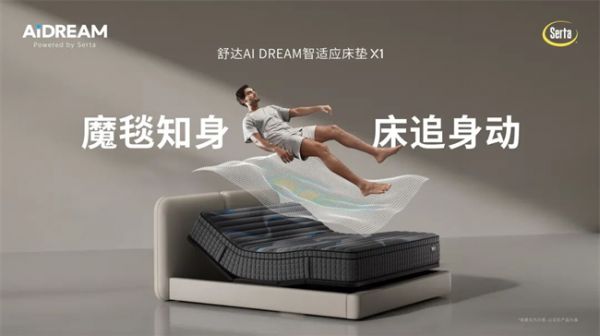
Why did Serta choose to launch AI Dream? The answer lies in the essential difference of the track. AI Dream is facing the proposition of "what should AI sleep look like." It is not just the intelligent upgrade of the existing mattress, but the redefinition of the sleep species.
Serta did not choose to continue adding on to the iComfort product line but instead allowed AI Dream to start independently. In the face of track-level transformation, it is necessary to define a new track with a new posture, and AI Dream is the answer that carries this mission.
The birth of AI Dream follows this logic. Serta, with nearly a century of bed-making history and the status of the world's number one in high-end smart bed global sales, chooses to enter the AI sleep track with the posture of an independent AI sleep technology new species to seize the discourse power. It shares Serta's global research and development system and century-old manufacturing capabilities, including the joint research and development with the Chinese Academy of Sciences, while with the Slogan of "Intelligent Sleep, More Than Dreams" and the value proposition of "More Than a Bed, an AI Sleep Butler Who Understands You," it completely separates from the brand recognition of "classic healthy sleep."
In the end, the competitive logic behind the sleep track has changed. If in the past the competition was about the lifespan of springs, the density of foam, and the skin-friendly degree of the fabric, now it is about who can use algorithms to make the bed truly "understand" a person's body. However, Serta has been able to detect this change and respond quickly.
Product Logic in the 3.0 Era
So far, the mattress industry has experienced three stages of evolution.
1.0 Electric Bed Era, solving the problem that the bed can move. 2.0 Smart Bed Era, achieving sleep data collection and monitoring. Most of the products on the market today are still at these two stages.
3.0 is the AI Embodied Intelligent Body Era, where AI large models give beds the ability to think. Unlike the "monitoring data and letting people read the report" in stage 2.0, stage 3.0 has achieved bed to actively respond to people's sleep needs. The first new product of AI Dream, Smart Adaptability Mattress X1, aims to define this 3.0 era.
This evolution is driven by the real sleep pain points of consumers.
Specifically, when couples sleep on the same bed, one likes a hard bed while the other prefers a soft one. For many years, they have had to accommodate each other. Serta AI Dream Smart Adaptability Mattress X1's 100-level independent softness and hardness adjustment system for left and right partitions can meet two kinds of sleep sensations at the same time, and there is no longer any need to argue about the mattress.
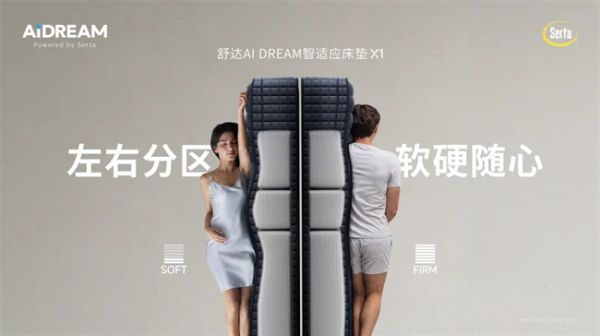
The human body is also changing. The same mattress may feel just right when young, but may be too soft in middle age; a few kilograms of weight gain can change the support feeling completely; even within one night, the demand for body support in the deep sleep stage is different. Serta AI Dream Smart Adaptability Mattress X1's self-adaptive following body comfort cabin supports 100 levels of softness and hardness adjustment, automatically matching the appropriate support level according to the pressure value of different parts of the body, and the bed changes with the human body.
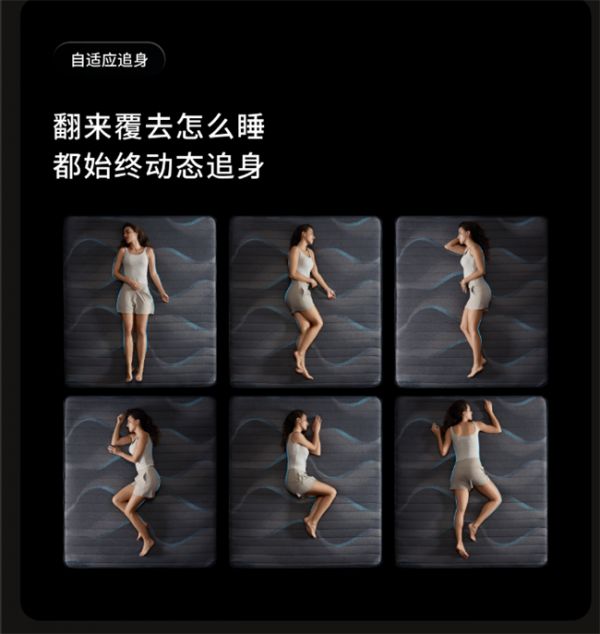
There is also an easily overlooked scenario: sleeping position. Most people flip over tens of times a night, and the contact points between the body and the mattress change every time they flip over. Traditional mattresses do not respond to this change, and people have to flip over repeatedly to find a comfortable position. Serta AI Dream Smart Adaptability Mattress X1's AI "Ultra-Sensitive Star Cloud Magic Carpet" has 65,000 high-precision imaging points, combined with 960 pressure sensing points, can accurately identify changes in sleeping position and allow the bed to adjust support in real-time to keep the body in the optimal stress state, and flipping over is just a natural action of users when they are truly asleep.
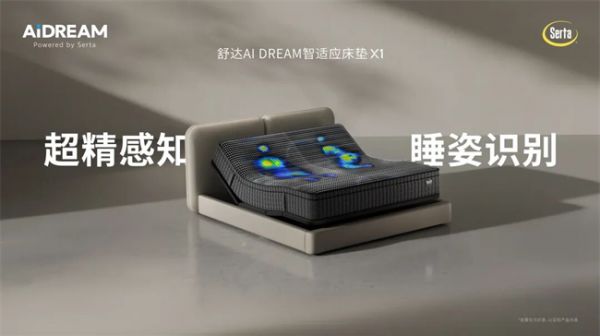
With the AI Non-Intrusive Sleep Analysis System, it can monitor more than ten indicators such as breathing rate and body movement without wearing, and generate a visual sleep report, turning the quality of sleep into traceable and improvable data.
The key data mentioned earlier are worth paying special attention to. Among them, what does 100-level adjustability of softness and hardness mean? The softness and hardness of traditional mattresses are fixed, and are finalized when leaving the factory. Serta AI Dream Smart Adaptability Mattress X1 uses the self-adaptive following body comfort cabin to cut the softness and hardness into 100 levels, automatically matching the most suitable support level according to the real-time pressure distribution of the human body. There are 960 pressure sensing points distributed in the core area of the mattress to ensure that every key part of the body is accurately sensed no matter whether the user sleeps on the side, lies flat, or flips over. And the 65,000 imaging points convert pressure data into a high-precision "body map," allowing the AI Dream engine to understand the user's body contour and sleep position changes with millimeter-level accuracy.
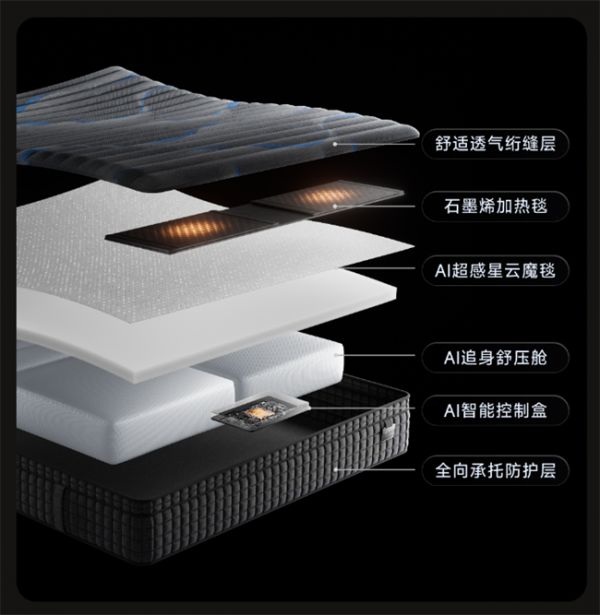
In simple terms, the logic of the whole set of technology is to hide complex algorithms and hardware calculations, leaving the user with an immersive sleep experience. It is no longer that people adapt to the bed, but that the bed adapts to people. This is the realization of embodied intelligence by AI Dream, and the hundred-year history of sleep has also turned the page.
Conclusion
The appearance of AI Dream means that there is an additional variable in this track. A 95-year-old mattress brand has incubated an AI sleep technology new species, with the "embodied intelligence" technical route and an independent posture, ready to compete with a group of AI smart sleep brands.
The result of the competition depends on two things: whether the technology is truly effective, and whether users are willing to pay for the "being understood by the bed" thing. From policy trends and market data, both answers are tilting towards "yes."
Humans have spent 700,000 years learning to make a good bed, and now it's time for it to learn to "think."
相关知识
AI赋能睡眠升级:床垫变AI终端3.0时代
智能睡眠的3.0时刻 :AI DREAM要让床垫变成AI睡眠终端
拥抱AI浪潮,慕思开启健康睡眠3.0时代
宋杰:AI赋能,蕾丝床垫打造女性“身心疗愈”睡眠
终端赋能“星”生态:星港打造睡眠经济时代标杆门店
AI重构全球睡眠格局,喜临门联手清华大学开启“AI陪伴”时代
从“人适应床”到“床适应人”,AI如何将“睡眠自由”夺回来?
人民健康睡眠中心启航,HEKA AI床垫引领智能睡眠新纪元
AI床垫发明者HEKA发布第六代AI床垫,引领健康睡眠新时代
2026中国女性睡眠白皮书发布,蕾丝AI床垫领航智能睡眠
网址: AI赋能睡眠升级:床垫变AI终端3.0时代 http://m.jiajubaike.cn/newsview154747.html