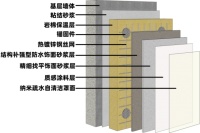
台迪解耦垫革新铺贴界,揭秘其魅力!
Understanding the Rise of Decoupling Pads in Tiling Industry
Recently, with the increasing demand for underfloor heating in residential buildings, large-format tiles, slab laying, and renovation of old houses, the term decoupling pad has gradually become a key issue in the tiling industry.
From commercial complexes to high-end residential buildings, from laying tiles on stone to renovation of tiles on tiles, more and more projects are starting to use the decoupling system to improve the long-term stability of the tiling system.
As one of the brands that have developed and applied decoupling pads earlier, tetti began to research and develop decoupling pad products in 2007 and has been exporting to the European market continuously. After more than a decade of product iteration and engineering practice, tetti decoupling pads have been applied in residential, commercial spaces, hotels, and large real estate projects, and completed approximately 30,000 square meters of domestic underfloor heating thin-laying stone engineering practice by 2025, promoting the further application of the decoupling system in high-quality tiling in China.
Why are more and more projects choosing decoupling pads?
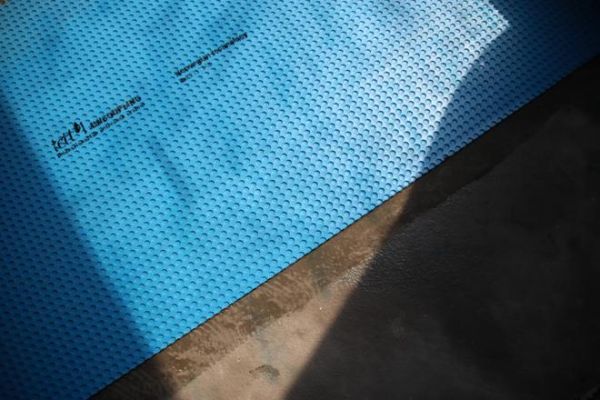
Decoupling Pad's First Value: Reduce Tile Cracking Risk from the Root
Many people think that tile cracking is due to poor tile quality or insufficient tile adhesive.
However, in many engineering projects, the real problem often comes from the sub-base.
During the use of buildings, the sub-base will produce stress due to temperature changes, operation of underfloor heating, and deformation differences between different materials. If the sub-base, tile adhesive, and decorative layer form a rigid connection, the stress will continuously transmit upwards, eventually concentrating on tiles or stones, increasing the risk of hollowing and cracking.
This is where the decoupling pad comes into play.
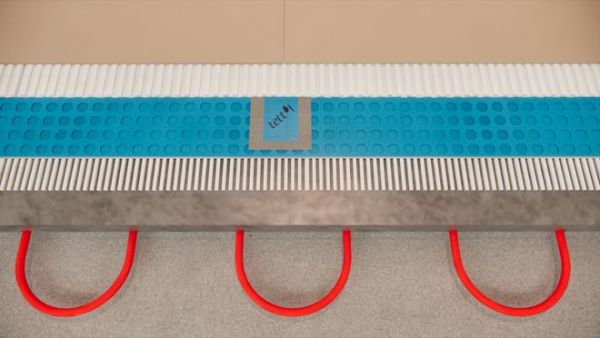
tetti decoupling pads break the traditional "sub-base - bonding layer - tile" rigid connection through a special physical buffering structure, allowing the sub-base and decorative layer to move independently and slightly, effectively reducing the stress transmission between different materials.
In other words, it is not to make the tiles stick tighter, but to give the entire tiling system the ability to "release stress," reducing the risk of cracking from the root.
Therefore, whether it is underfloor heating laying, large-format slabs, natural stones, or old brick renovation, the decoupling anti-cracking system can provide a more stable working environment for the tiling layer.
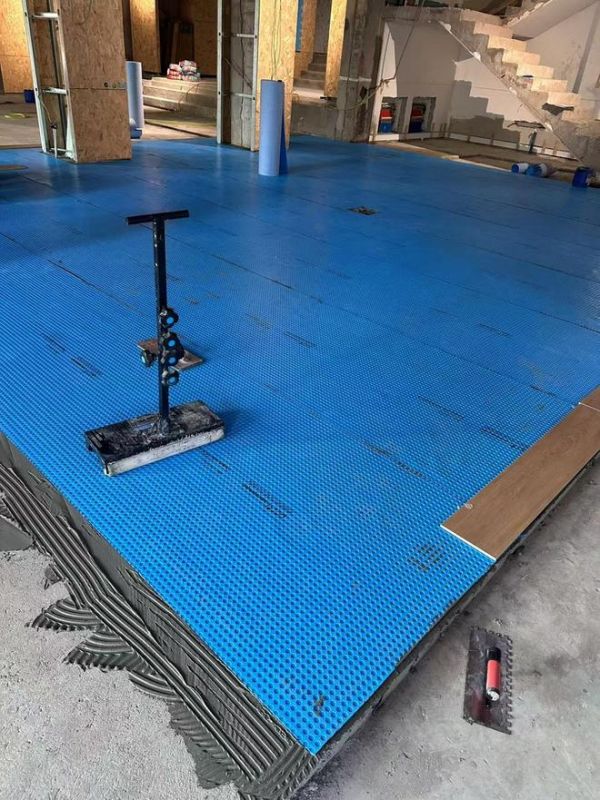
Decoupling Pad's Second Value: Block Moisture, Keep the Space Dry
In addition to anti-cracking, moisture is also an important factor affecting the durability of the tiling system.
Especially in areas such as bathrooms, basements, and ground floors, the moisture of the sub-base migrates upwards for a long time, which may affect the performance of the bonding layer and easily cause space dampness, odor, and even mold growth.
tetti decoupling pads are made of dense polymer materials and have good impermeable properties, which can effectively block the migration of moisture from the sub-base to the decorative layer, adding a moisture-proof barrier to the tiling system.
At the same time, tetti decoupling pads use a thin-laying system for construction.
Compared to the traditional thick-laying technology, it greatly reduces the thickness of the mortar layer, allowing the tile adhesive to dry and solidify faster, and the residual moisture in the construction process is easier to volatilize, reducing the possibility of odor and mold due to long-term dampness.
For modern residential buildings, moisture-proof not only concerns the quality of tiling but also directly affects the living experience.
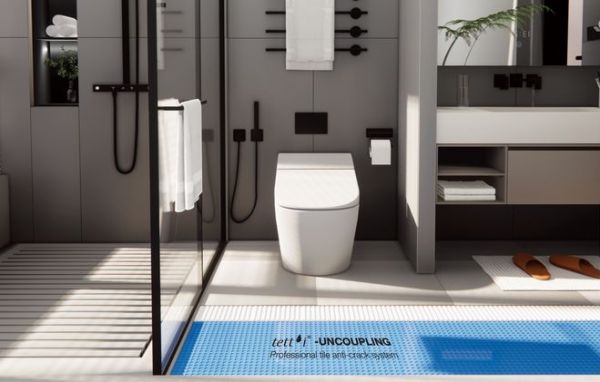
Decoupling Pad's Third Value: Even Heat Distribution for Underfloor Heating
In recent years, underfloor heating residential buildings have become an important configuration for improved residential buildings.
However, many people ignore that the real impact on comfort is not only the heating equipment but also the tiling system.
The traditional thick mortar laying, due to the uneven thickness of the mortar, is prone to different heat transfer speeds, resulting in temperature differences in local areas.
tetti decoupling pads have a special structural design internally, forming a uniform air layer after laying, which allows heat to be transmitted and radiated more uniformly upwards.
This structure helps to reduce the problem of uneven hot and cold in local areas, making the distribution of the underfloor heating temperature more balanced and improving the overall comfort level.
Therefore, in more and more high-end residential buildings and underfloor heating stone projects, decoupling pads have become an important part of the tiling system.
From European Applications to Large-Scale Domestic Engineering Practice
Whether a material is truly mature ultimately depends on engineering verification.
tetti has been researching and developing decoupling pads and exporting to the European market since 2007, accumulating rich practical experience over the long-term application.
In 2020, tetti completed a representative tile-on-tile commercial renovation case in Shanghai Changning District, the Zhongxi Building, through the decoupling system, achieving the direct laying of 4mm thin plates on the existing tile sub-base, with a total completed area of only 14.2mm, without removing the old tiles, greatly shortening the construction period.
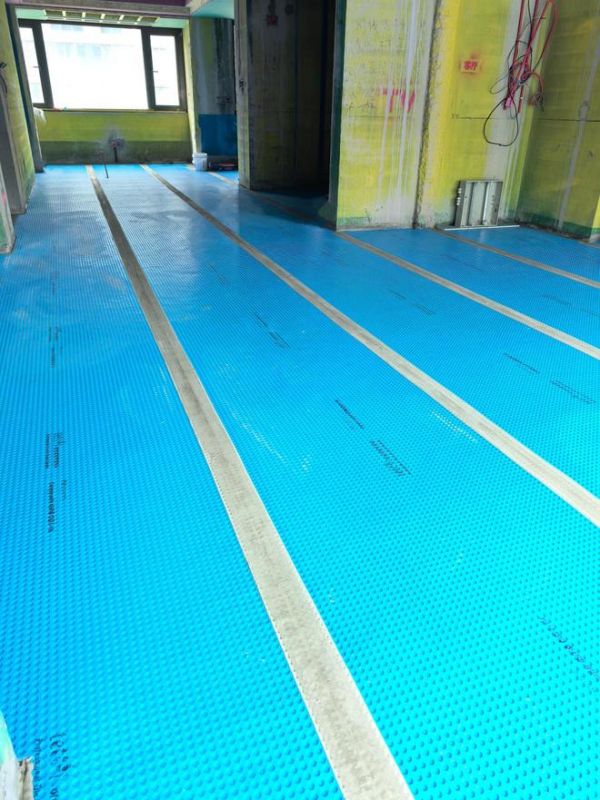
In 2025, the 30,000 square meters of underfloor heating thin-laying stone project in Xi'an, Shaanxi, China, used tetti decoupling pads for construction, becoming one of the domestic large-scale decoupling engineering practice cases, further verifying the application value of decoupling pads in underfloor heating and high-value decorative material laying.
Why Are More and More Designers Starting to Pay Attention to Decoupling Pads?
In the past, people focused on whether the tiles could stick; now, people are more concerned about whether they will still be stable ten years later.
With the popularization of underfloor heating, large-format tiles, slabs, natural stones, and old house renovations, the tiling industry is moving from "material thinking" to "system thinking."
Decoupling pads are not a new type of decorative material but an important functional layer that connects the sub-base and decorative layer.
As an early developer and deep developer in this field, tetti hopes to promote not only a product but also a more stable and durable systematic tiling concept. In the future, as the demand for high-quality residential buildings and refined construction continues to rise, the decoupling anti-cracking system will also play a value in more engineering projects.
相关知识
tetti台迪|解耦垫有哪些作用?读懂tetti解耦垫的三大核心价值
tetti台迪|解耦垫正在改变铺贴行业,你了解它吗?
tetti台迪 | 告别瓷砖岩板开裂!一文读懂“解耦垫”黑科技
tetti台迪|从出口欧洲到落地中国,tetti解耦垫20年的发展与实践
tetti解耦垫:欧洲出口至中国,20年实践见证
《梦想改造家》携手tetti台迪,新材料解70㎡老房三大难题
《梦想改造家》携手tetti台迪,新材料破解70㎡老房改造难题
《梦想改造家》X tetti台迪:新材料解决70㎡老房改造三大难题
tetti台迪|荣登WAD全球豪宅健康品牌TOP 100,以环保诠释健康人居新标准
台迪卫浴翻车:基层装修隐患?
网址: 台迪解耦垫革新铺贴界,揭秘其魅力! http://m.jiajubaike.cn/newsview151820.html