程和平《可丁可卯》:设计方法论实践与体系
Design Methodology: Cheng Pinghe and His "Ke Ding Ke Yao" Approach From Practice to System: Cheng Pinghe and His "Ke Ding Ke Yao" Design Methodology 
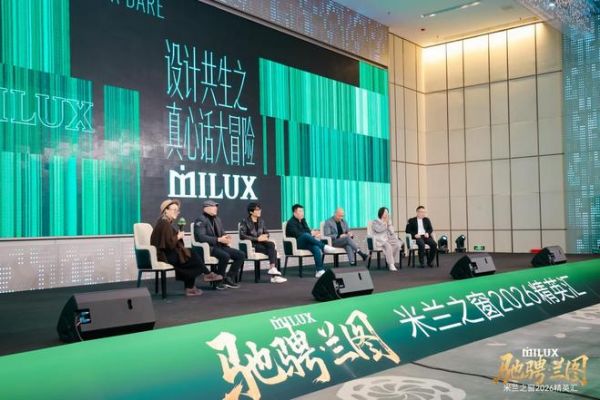
In an era of rapid iteration, every industry faces its core questions. For the current Chinese design field, the question is: when market "involution" becomes the norm, and when clients' professional understanding exceeds that of practitioners, where lies the true value barrier of designers? In the recently highly关注的 "Cheling·Lantuo | Milan Window 2026 Elite Summit" within the industry, a summit not only pushed this question to a climax but also focused the industry's attention on a design thinker - the founder of Zaoyi Architectural Design, Cheng Pinghe, and the systematic answers he provides to the industry.
Observations in the Industry Transformation Period: Returning to the Essence of Professionalism

In this summit organized by Milan Window, which gathered many outstanding domestic designers, the focus of the discussion was on "how to respond to the increasingly rational market environment." Cheng Pinghe proposed in his speech that the current client group has undergone a fundamental change - they have a very high aesthetic sense and international vision.
"In the past, designers led the owners, but now the owners often have more insights than we imagine," Cheng Pinghe confessed. Faced with this change, he believes that the moat of designers is no longer fragmented inspiration, but systematic and testable professional logic. This view triggered deep resonance among the participants and revealed the principles he has always adhered to in design practice.
The views shared by Cheng Pinghe at the forum originate from his seventeen years of design practice and in-depth thinking. This experience and methodology, which has been tested over a long period, has finally been systematically organized and presented in his recently published professional work - "Ke Ding Ke Yao Design Memoirs." The book is not a simple collection of works but an important sedimentation of the refinement of first-hand practical experience into professional theory.
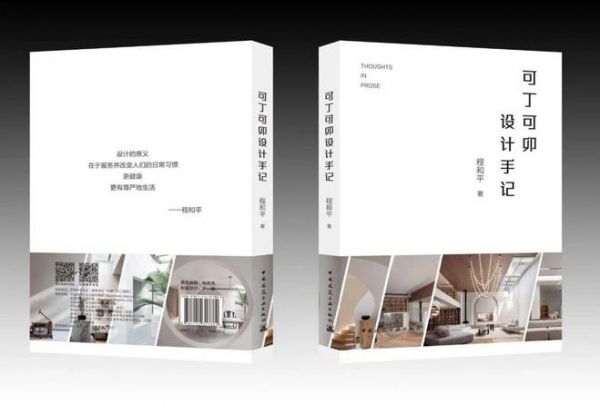
"Ke Ding Ke Yao," a term with a northern regional color, is defined by him as a "strict but just" design standard. In the book, he breaks it down into three core dimensions, striving to find a balance between rigorous engineering scale and free spatial experience:
"Not burdened by objects": He advocates that design should solve the redundancy in life, through precise scale optimization, so that objects truly serve people's daily behavior, rather than making space a cluttered display. "Behavioral design" guidance: He tries to guide healthier living habits through spatial layout, subtly influencing people's perception of space temperature and order through预留 of light and shadow and planning of movement lines. "Cross-border inspiration" refinement: He proposes to jump out of design to see design, absorbing logic from architecture, art, even competitive sports, to avoid homogenization competition within the industry and maintain the uniqueness of works.Industry Value: From Personal Experience to Professional Sharing
As a long-term active designer on the front line, Cheng Pinghe's work has long exceeded the scope of completing individual projects. He is committed to transforming his design experience into a systematic methodology that can be referenced by the industry. The Milan Window Elite Summit provides an important opportunity for the exchange of cutting-edge industry thoughts. What Cheng Pinghe shared at the forum is the core ideas of his book "Ke Ding Ke Yao Design Memoirs." In this book, he decomposes his unique "space gene" 36 methods and his pursuit of the simple design proposition of "beautiful and practical," which is not only a summary of his personal professional thinking but also a practical professional reference for the industry on how to improve service standards in the "highly knowledgeable customer era."
In the vision of "design symbiosis," the dialogue between Milan Window and outstanding designers like Cheng Pinghe is actually a return to the "professional spirit." Cheng Pinghe practices his respect for design with his seventeen-year persistence and this design memoir - with people as the measure and rigor as the foundation. This deep research into professionalism and selfless sharing is becoming an important force driving the Chinese design industry to higher standards.
相关知识
从实践到体系:程和平与他的《可丁可卯》设计方法论
和平大道 中式
和平新城
和平家园145㎡中式风格
专访金螳螂品宅设计院院长欧阳毅,探究豪宅设计装饰方法论
沉浸于至臻音质:宝华韦健与和平饭店共谱奢华新章
完善人才教育体系,融入前沿设计思维,墨鱼设计学院树立行业“创新标杆”
新浪家居走进红星和平
科勒访谈:聚焦“好房子”与健康人居实践
科勒做客人民网《人民会客厅》,聚焦“好房子”建设与健康人居实践
网址: 程和平《可丁可卯》:设计方法论实践与体系 http://m.jiajubaike.cn/newsview142139.html